

Walkabouts Platform and Students with ADHD
How the Walkabouts Platform Supports Students with ADHD
Attention Deficit Hyperactivity Disorder (ADHD) is the most common neurodevelopmental disorder in children, with a global prevalence estimated at 7.2%.¹ According to a study from the Centers for Disease Control and Prevention published in 2024, approximately one million more children had ever received an ADHD diagnosis in 2022 than in 2016.2
As diagnoses rise, the need for supportive, research-backed classroom tools grows too. The Walkabouts Platform was designed with these needs in mind—integrating physical activity directly into standards-based academic instruction to help students with ADHD improve focus, reduce behavior challenges, and stay actively engaged in learning.
How Does Physical Activity Help Children with ADHD?
-
Improves Executive Function3
-
Decreases Behavior Challenges4
-
Improves Focus: According to a 2015 study by the MIND Institute at the University of California-Davis, physical activity allows children with ADHD to focus on what they are doing. In children with a diagnosis of ADHD, the study found:
-
Children who moved more intensely showed better cognitive performance.
-
The accuracy of children’s performance on tests significantly improved when they were moving.
-
-
Hyperactivity in children with ADHD may help them think.5
How Are Kinesthetic Learning and ADHD Diagnoses Connected?
Many children seen at the National Reading Diagnostics Institute in Naperville, Illinois had previously received a diagnosis of ADHD. In-depth reading evaluations often showed that rather than having ADHD, these children were kinesthetic learners who needed to engage in gross motor activity to learn best.6
Walkabouts Platform Integrates Movement and Learning
Teaching the elementary curriculum with specific emphasis on fundamental movements may decrease the symptoms associated with ADHD.7
Multisensory tools such as the Walkabouts Platform:
-
Minimize ADHD challenges.
-
Boost academic performance.
-
Improve student behavior.
-
Enhance overall health and wellness.
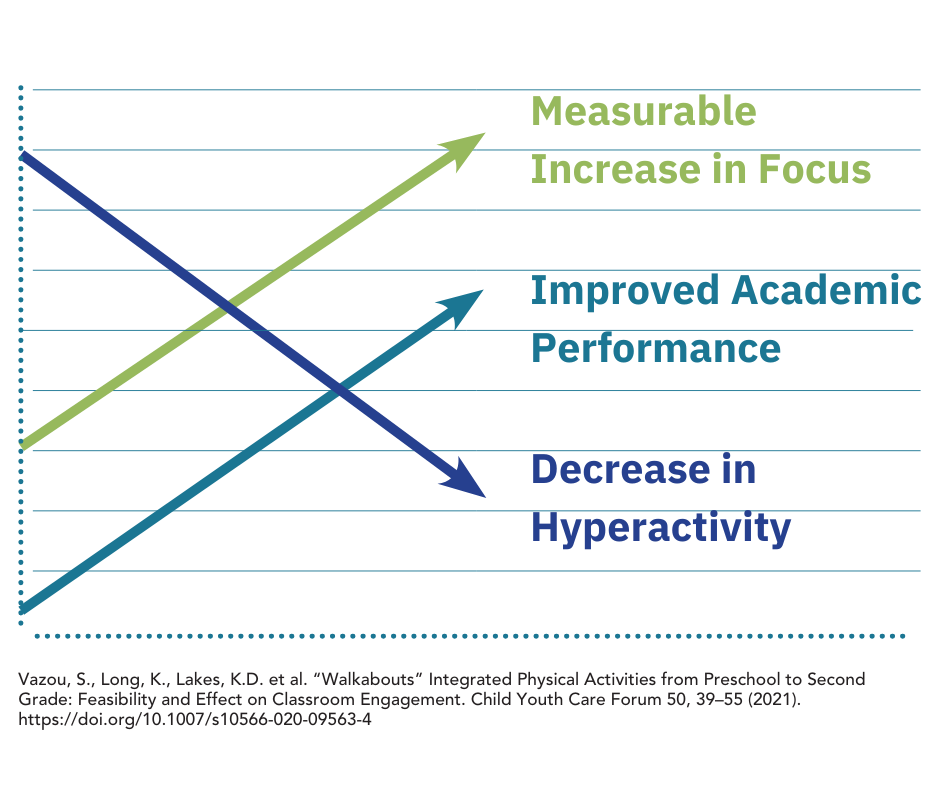
independent researchers at Iowa State University and the University of California at Irvine demonstrated that pre-K to 2nd grade students using Walkabouts’ physically engaging lessons for eight weeks showed significant improvements in attention, hyperactivity, and performance.8
What the Research Shows
Why Is Physical Activity Important for Students with ADHD?
References
1. Anita Thapar and Miriam Cooper. “Attention Deficit Hyper Activity Disorder,” Lancet, 387 (10024) (2016): 1240-1250, https://doi.org/10.1016/S0140-6736(15)00238-X.
2. Melissa Danielson et al. “ADHD Prevalence Among U.S. Children and Adolescents in 2022: Diagnosis, Severity, Co-Occurring Disorders, and Treatment,” Journal of Clinical Child & Adolescent Psychology, (2024). https://doi.org/10.1080/15374416.2024.2335625.
3. Rae Thomas et al. “Prevalence of Attention-Deficit/Hyperactivity Disorder: A Systematic Review and Meta-Analysis,” Pediatrics, 135 (4) (2015): e994–e1001. https://doi.org/10.1542/peds.2014-3482.
4. Yu Zang. “Impact of Physical Exercise on Children with Attention Deficit Hyperactivity Disorders: Evidence Through a Meta-Analysis,” Medicine (Baltimore), Nov. 98 (46) (2019): e17980. https://pubmed.ncbi.nlm.nih.gov/31725664/.
5. Arthur Hartanto et al. “A Trial-by-Trial Analysis Reveals More Intense Physical Activity Is Associated with Better Cognitive Control Performance in Attention-Deficit/Hyperactivity Disorder,” Child Neuropsychology, 22 (2016): Issue 5. https://doi.org/10.1080/09297049.2015.1044511.
6. Ricki Linksman, How to Learn Anything Quickly: Quick, Easy Tips to Improve Memory, Reading Comprehension, Test-Taking Skills, and Learning through the Brain’s Fastest Superlinks Learning Style, Naperville: National Reading Diagnostics Institute, 2013.
7. Julian A. Reed, Active Education: Lessons for Integrating Physical Activity with Language Arts, Science and Social Studies. New York: Nova Science Publishers, Inc., 2009.
8. Spyridoula Vazou et al. “‘Walkabouts’” Integrated Physical Activities from Preschool to Second Grade: Feasibility and Effect on Classroom Engagement.” Child & Youth Care Forum, 50, (2021): 39–55. https://doi.org/10.1007/s10566-020-09563-4.
